
6 Ways to Pay International Invoices Cheaply and Securely in 2026




Do you have to pay overseas invoices? Paying international invoices as a business, or as a personal customer for things like school fees, medical expenses, or utility bills, can be difficult, time-consuming, and expensive. Sometimes it can even be risky. But it doesn't have to be.
In this article, we will look at 6 methods that offer safe, cheap, and fast ways to pay international invoices. We'll explore their pros and cons, and when they can be a good option.
Key takeaways: Paying foreign invoices
- The best way to pay an international invoice ultimately depends on the payment terms set by the vendor.
- There are several ways to pay international invoices, including bank transfers, online payment providers, credit card payments, and multi-currency business accounts from providers like Wise and Revolut.
- Each method has trade-offs in terms of fees, exchange rates, and speed. This guide will help you compare your options.
- Providers like Wise, Revolut, and OFX can be convenient and cost-efficient solutions for paying international invoices.
- Wise Business and Revolut Business offer international business account services. Wise uses the mid-market exchange rate for currency conversions, with fees that vary by currency and payment method. Revolut Business supports 25+ currencies and offers different account tiers to help you manage your spending more easily.
What's the safest way to pay an international invoice?
Sending money overseas can seem risky, but choosing a reputable provider and taking sensible precautions can help reduce the risks. Here are some of the security measures and support options offered by the providers covered in this guide:
- OFX: Secure account login, multi-factor authentication, fraud monitoring, and 24/7 customer support.
- Wise: Two-step verification, account security controls, and support through official customer service channels.
- Revolut: Account verification and automated fraud-detection measures.
- Remitly: Security measures and guidance on identifying and avoiding scams.
- Xe money transfer: Account security and fraud-prevention measures.
- PayPal: Account verification, login security features, and customer support.
- Western Union: In-person agent services where available, digital transfer tracking, and customer support.
- Using credit cards: Fraud protection and potential consumer protections, depending on the card, transaction, and applicable law.
How to avoid international invoice fraud
Before making an international invoice payment, independently verify any unexpected changes to the recipient's bank details. Contact the supplier using a phone number or contact method you already know, rather than relying on the contact details in a suspicious email.
Check the recipient's name, account details, invoice amount, currency, and payment reference before confirming the transfer. If anything looks unusual, contact the supplier before sending money.
6 ways to pay international invoices
| Methods | Great for: |
|---|---|
| International money transfer | Payments to recipients who prefer to receive money directly into their bank account. Fees and receiving charges depend on the provider and destination. |
| Wise | International bank transfers, including high-value payments, with transparent fees and estimated delivery times shown before confirmation. |
| Use an international business account | International business accounts from specialist providers can offer flexible ways to send and receive payments in supported currencies. |
| PayPal | Payments to recipients who accept PayPal, including businesses that provide a PayPal payment option. |
| Paying with a credit card | Convenient payments when an invoice includes a card payment link. Credit may allow costs to be spread over time, subject to interest and other charges. |
| Western Union | Sending money for cash collection in supported locations, sometimes within minutes, depending on the destination and service. |
1. Pay through an international money transfer provider
International money transfers can be made directly into a recipient's bank account. This is a common way of paying overseas bills and can be done through banks like Barclays or Lloyds, or specialist money transfer providers like Wise, OFX, and WorldRemit. Wise is included in this category and is examined separately in the next section.
The table below compares fees, exchange rates, transfer limits, and estimated delivery times for some UK payment providers.
| Provider | International transfer fees | Exchange rates | Transfer limits | Transfer speed |
|---|---|---|---|---|
| OFX | No OFX transfer fee for UK currency transfers; third-party bank fees may apply | Exchange rates may include a markup | No OFX maximum; bank limits may apply. Minimum £100 for major currencies | Generally 1–2 business days after OFX receives cleared funds; varies by destination |
| Wise | Variable fee from 0.33%, depending on currency and payment method | Mid-market rate | Depends on currencies and how you pay; some GBP transfers can reach £20 million | 77% arrived within 20 seconds and 97% within 24 hours in Q2 2026; individual transfers vary |
| Remitly | Variable fee based on country, currency, and payment method | Exchange rates may include a markup | Up to £75,000 per transfer from the UK; individual limits can be lower | Varies by country and receiving method |
| Xe money transfer | Variable fee based on country and currency | Exchange rates may include a markup | £375,000 daily online limit for UK personal customers; business limits differ | Varies by destination and payment method |
| Barclays Business | £15 for a Barclays International Payment online or in the app; £25 in person or by phone. SEPA rates differ | Exchange rates may include a markup | £100,000 per payment, within a £250,000 cumulative daily online limit | Depends on destination and currency |
| Lloyds Business | £15 via internet banking; £28 in branch for standard international payments. Other payment types differ | Exchange rates may include a markup | £250,000 per day via Online for Business | Depends on destination and currency |
Selected UK fees, limits, and delivery estimates were rechecked against provider information on November 2026. Personal and business accounts may have different conditions; review your live quote before paying.
When is this a good option?
An international money transfer is a good option if:
- The issuer of the invoice has an eligible bank account you can pay into
- The person you're paying won't get charged high recipient fees by their own bank
- The invoice is fairly large – some banks and money transfer providers only allow bill payments over a certain amount
- You have a unique reference such as an invoice number which you can include as a message on the transfer so your payment can be identified easily
Pros and cons of paying a bill via an international money transfer
| International money transfer pros | International money transfer cons |
|---|---|
|
|
How to pay an international invoice with an international money transfer
- Log in to your online or mobile banking service
- Navigate to the payment section and select international transfers
- Enter the amount and currency you need to send
- Add your recipient's details and your payment reference
- Check the recipient, fees, exchange rate, and reference, then confirm your transfer
Best international money transfer apps to pay invoices
There are many alternatives to banks for international money transfers. Apps from providers like OFX, Wise, and WorldRemit might be faster and cheaper than banks.
The best international money transfer app for you will depend on your needs. You can compare providers and choose the best one for yourself.
- OFX: Send money to supported countries in multiple currencies. OFX offers money management tools, including risk management
- Wise: Fast, convenient payments to supported destinations. Wise uses the mid-market exchange rate and has a transparent fee structure
- Revolut: Pay eligible recipients in supported currencies. Tiered accounts offer different services, and business customers can use spending analytics
- WorldRemit: Send money to over 130 countries via its app, using available funding and receiving methods. WorldRemit offers 24/7 in-app support; phone-support hours vary
- Remitly: Transfer money to supported destinations with various payment and delivery methods. A cash pickup option is available in some countries
2. Wise: international transfers for invoices
Wise offers personal and business accounts and international money transfers with transparent fees, mid-market exchange rates, and transfer speeds that depend on the payment. With Wise Business, you can pay invoices and make recurring payments to supported countries and currencies.
You can also get debit and expense cards for you and your team, and receive money in foreign currencies conveniently. Wise Business customers get extra features including cloud accounting integrations, multi-user access, and an API to streamline workflows.
Launched in 2011 in the UK, Wise serves personal and business customers worldwide. Wise is not a bank.
The table below summarises Wise Business transfer coverage, costs, limits, and speeds.
| Provider | Coverage | International transfer fees | Exchange rates | Transfer limits | Transfer speed |
|---|---|---|---|---|---|
| Wise | Business payments to 160+ countries, subject to supported currencies and routes | From 0.33%; fee varies by currency and payment method | Mid-market rate | Varies by currency and payment method | 77% within 20 seconds; 97% within 24 hours in Q2 2026, depending on transaction |
Wise pricing and reported transfer speeds checked on November 2026. The speed percentages describe Q2 2026 performance, not a guarantee for individual payments.
When is this a good option?
Wise is a good option if:
- You need a fast, convenient, and low-cost way to pay invoices
- You prefer to manage your money online or by app
- You need one-off or recurring payments, or batch payouts to up to 1,000 recipients at once with an eligible Wise Business account
- You're sending anything from small invoices to large payments, subject to the currency, payment method, and Wise limits that apply
Pros and cons of using Wise for international money transfers
| Wise pros | Wise cons |
|---|---|
|
|
How to pay an international invoice with Wise
- Log in to your Wise account online or in the app
- Select Send money
- Enter the amount you need the recipient to get, and the currency
- Choose your payment method and add your recipient details – if you've sent money to this recipient before, you can pick them from your recipient list. Add the invoice reference where supported
- Review the fees, exchange rate, recipient, and payment reference, then pay
Learn more – How to open a Wise Business account in the UK and Wise Business Account Review.

3. Pay from a multi-currency business account
These days, most banking can be done online, so it can make sense to set up an international business account you can manage digitally, which supports foreign currencies for sending and receiving. There are various options, including international business accounts from specialist providers which are designed for sending payments overseas, holding foreign currencies, and receiving money conveniently.
Once the account is open, you can receive payments into your international business account – or add money to the account yourself – and then use it to pay bills as they arise.
- The Wise Business account offers account details for supported currencies including EUR, USD, CAD, and GBP. It also allows eligible customers to hold and convert 40+ currencies
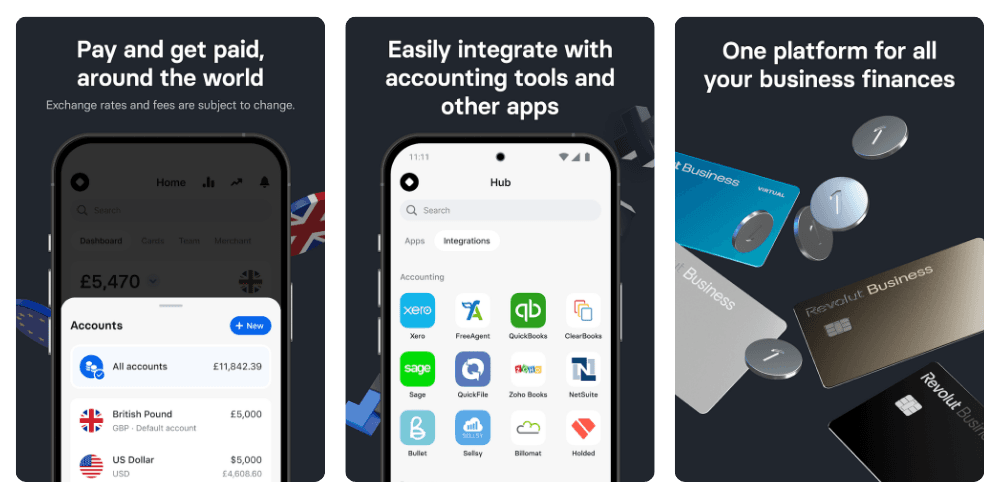
- Revolut Business offers Basic (£10/month), Grow (£35/month), Scale (£125/month), and custom-priced Enterprise plans, as listed in its UK business fee schedule. You can manage balances in 25+ currencies
The table below compares the main Wise Business and Revolut Business account costs and international transfer terms.
| Provider | Coverage | Account fees | Transfer fees and exchange rates | Transfer limits | Transfer speed |
|---|---|---|---|---|---|
| Wise Business account | Send to 160+ countries in supported currencies | £50 one-off set-up fee for Wise Business features and account details in the UK | Transfer and conversion fees from 0.33%, depending on currency and payment method; mid-market rate | Depends on currencies and how you pay | 77% of transfers within 20 seconds and 97% within 24 hours in Q2 2026; individual speeds vary |
| Revolut Business account | Business accounts support 25+ currencies; destinations and payment methods vary | Basic £10/month; Grow £35/month; Scale £125/month; Enterprise custom | International payments £5 each outside the plan allowance (0 free on Basic, 5/month on Grow, 25/month on Scale). FX allowance varies; 0.6% above allowance and 1% outside market hours | Varies by currency, payment type, and account | Varies by country, currency, and payment route |
Listed UK business plan prices and fee schedules reviewed on November 2026. Revolut fees can differ with monthly or annual billing and plan eligibility; check the current plan terms.
When is this a good option?
Setting up an international business account is a good option if:
- You regularly pay several bills in the same country
- You've found an account you like which you're eligible to apply for
- You need to pay foreign contractors or freelancers on a regular basis
Pros and cons of setting up an international business account
| International business account pros | International business account cons |
|---|---|
|
|
How to pay an international invoice with a multi-currency business account
- Log in to your international business account and select transfers
- Add money to your account if there isn't enough in the balance already
- Enter the amount your recipient should receive in the local currency
- Add your recipient's information and the invoice reference if the provider supports it
- Check the fees and payment details, then initiate the transfer
4. Pay via PayPal
PayPal is one of the world's largest online payment companies. It is easy to set up an account, but you can only use it to pay an overseas invoice if your supplier accepts PayPal. Fees and exchange rates depend on whether you're paying for goods or services, receiving a commercial payment, or using a separate business payouts product.
The table below summarises key conditions for paying international invoices with PayPal.
| Provider | Coverage | International payment fees | Exchange rates | Transfer limits | Transfer speed |
|---|---|---|---|---|---|
| PayPal commercial payments | Supported PayPal accounts and currencies; supplier must accept PayPal | Depends on transaction type and recipient market. The 2% fee with currency caps applies to the separate PayPal Payouts service, not automatically to ordinary invoice payments | Currency conversion spreads may apply; check the rate shown by PayPal. Compare with today's PayPal exchange rate | Account and payment-specific limits apply | Varies by payment type and review requirements |
PayPal UK merchant fee information was updated on 1 October 2026 and reviewed for this section on November 2026. Check the payment type before applying any published fee.
When is this a good option?
PayPal is great to pay bills if:
- You already have a PayPal account
- Your recipient accepts PayPal instead of a direct bank deposit
- You use PayPal frequently for your own business transactions
Pros and cons of paying a bill by PayPal
| PayPal pros | PayPal cons |
|---|---|
|
|
How to pay an international invoice with PayPal
- Log in to your PayPal account online or in the app, or use a PayPal payment link provided by the supplier
- Select the appropriate payment for goods or services, where applicable
- Enter the amount and currency to send
- Add your recipient's PayPal-linked email address, if paying through the Send money flow
- Check the recipient, applicable fees, currency conversion, and payment details before confirming
5. Pay by credit card
Many people pay overseas bills with their credit cards when the supplier offers a card payment option. This can be costly if banks and card issuers charge fees for payments in foreign currencies or apply interest. A direct money transfer funded by a credit card is a different transaction and may involve cash advance or money transfer fees.
The table below summarises costs and limits for paying overseas invoices by credit card.
| Method | Coverage | Fees and exchange rates | Limits | Payment speed |
|---|---|---|---|---|
| Paying a foreign invoice by credit card | Where the supplier accepts your card and card network; restrictions apply | Interest may apply if you do not repay in full. Foreign transaction fees, exchange rate conversion costs, and possible cash advance or money transfer fees depend on the card and payment type | Usually depends on your available credit and any card or merchant limits | Card authorisation is often immediate; settlement to the merchant may take longer |
The relevant fee and protection rules depend on your card agreement and the payment mechanism; check these before paying.
When is this a good option?
Using a credit card to pay bills can be a good option if:
- You need to spread your costs over a few months and understand the interest and fees involved
- You're making small international bill payments that the merchant accepts by card
- You don't want the hassle of setting up international money transfers, and the invoice includes a legitimate card payment option
Pros and cons of paying a bill by credit card
| Credit card pros | Credit card cons |
|---|---|
|
|
How to pay an international invoice with a credit card
If your invoice includes a genuine card payment link, open it and follow the instructions. Verify unexpected payment links directly with the supplier.
If no card payment link is provided, ask the supplier whether they accept credit cards. A credit card does not automatically let you send a normal bank transfer to the supplier; a separate money transfer or cash advance facility may have different costs and terms.
- Open the supplier's verified card payment page
- Check the supplier name, invoice amount, and currency
- Enter your credit card details and complete any required authentication
- Review the payment and save the confirmation and invoice reference
6. Pay through Western Union cash pickup
Western Union offers international transfers across more than 200 countries and territories, including cash collection at agent locations where available. It can be useful when a trusted recipient needs to collect cash, but cash pickup is not suitable for every invoice or merchant payment.
The table below summarises Western Union's international transfer conditions.
| Provider | Coverage | International transfer fees | Exchange rates | Transfer limits | Transfer speed |
|---|---|---|---|---|---|
| Western Union cash pickup | Cash collection in supported locations; global network across 200+ countries and territories | Variable fees depending on transfer details | Exchange rates may include a markup | Varies by destination and payment/collection method; UK transfers may reach £50,000 on eligible routes | Cash may be available within minutes, but timing varies by local agent hours, destination, and checks; bank deposits can take longer |
Service coverage, speed, and limits reviewed on November 2026; verify the specific route before making a payment.
Important: Western Union advises customers not to send cash transfers to people they have not met or for unfamiliar online purchases and similar requests. Cash pickups can be difficult to recover after collection. Verify the recipient independently and use a suitable commercial payment method for ordinary supplier invoices.
When is this a good option?
Western Union may be a good option if:
- The trusted recipient doesn't have a bank account
- The recipient would prefer to collect cash and the proposed payment is permitted by Western Union's service terms
- The recipient is in a destination where Western Union offers an eligible cash pickup service
Alternative providers like WorldRemit and Remitly also offer cash pickup options on eligible routes. Learn more about Western Union alternatives in the UK.
Pros and cons of paying a bill via Western Union
| Western Union pros | Western Union cons |
|---|---|
|
|
How to pay an international invoice with Western Union
- Log in to your Western Union account
- Select Send money and enter the amount and currency
- Choose how you want to pay and how the recipient should receive the funds, if the payment is eligible
- Review the fees, recipient, and transfer details before funding the payment. For cash pickup, provide the transfer tracking reference only to the verified recipient and follow the collection instructions
How to pay international invoices
The steps to pay international invoices may differ depending on which method or provider you choose.
Keep in mind that some international payment methods can have lower costs but longer delivery times, while others may have shorter delivery times at higher costs. Consider this when choosing a provider, then follow the steps to set up an international bill payment or pay a foreign contractor.
While the steps to pay international invoices may vary between providers, they usually involve some of the following:
- Create an account and complete any required identity or business verification, if the payment method requires one
- Fund the account by adding money or linking an eligible bank account or debit or credit card, where applicable
- Enter the recipient's payment details or choose a saved recipient, and include the invoice reference where supported
- Select the invoice currency and, if a conversion is needed, the currency you're paying from
- Review the exchange rate, fees, recipient amount, and estimated delivery time before confirming
- Submit the payment and keep its confirmation or tracking reference
How to pay invoices in foreign currency
Paying an invoice in a foreign currency can be expensive because exchange rates, conversion markups, and transfer fees vary between providers and payment methods. Banks and credit card issuers may apply foreign transaction charges or exchange rate markups.
You may be able to save money by using online international money transfer specialists like Wise and OFX. These providers may offer faster transfers, lower overall costs, or more favourable exchange rates than some bank services, depending on the payment.
Providers like Revolut Business and Wise Business also offer multi-currency business accounts. Eligible customers can receive money using account details for selected currencies and hold balances to pay future invoices. If you already hold enough of the invoice currency, you may avoid converting money at the time of payment. However, converting money to fund the balance and sending the payment may still incur fees.
Wise Business account: Wise Business lets you pay invoices to supported destinations and, with eligible UK account features, receive money using local or SWIFT account details in selected currencies, including EUR, USD, CAD, and GBP. It allows you to hold and exchange 40+ currencies. Wise Business debit and expense cards can also be used for eligible business purchases. Wise Business Advanced account details are subject to the applicable one-time setup fee.
Revolut Business account: Revolut offers Basic (£10/month), Grow (£35/month), Scale (£125/month), and custom-priced Enterprise plans for UK businesses. Accounts support holding, sending, and receiving 25+ currencies, while Revolut Business cards can be used to spend in 150+ currencies. Integrations include Slack, Xero, and QuickBooks, with availability depending on the plan and region. Foreign exchange and transfer fees may apply.
What currency should I pay in?
Before you do anything with your international invoice, make sure you're clear about which currency you should be paying in. You can agree on the invoice currency upfront with your supplier before you complete the deal negotiations – which leaves less room for misunderstandings or hassle later.
Which currency is best depends on what the supplier agrees to accept and on the total costs for both sides. Some suppliers, freelancers, or contractors will want to be paid in their own home currency so the money can be deposited into their business account without an additional currency conversion.
Some recipients may prefer you to send GBP if they have an account that can receive pounds. They can then keep the balance in GBP for future payments, but exchange rates can move in either direction. Before agreeing to pay in GBP rather than the invoiced currency, check whether the recipient accepts it and whether their bank or account provider may charge conversion or receiving fees.
How to pay invoices in a foreign currency
You can pay an invoice in a foreign currency by setting up an international money transfer and having the bank or provider convert your GBP into the currency needed. Alternatively, if you already hold the required currency, you can pay from an eligible multi-currency business account like Wise or Revolut Business. Which option is cheaper or easier depends on your balance, exchange rate, transfer fees, and the recipient's payment terms.
Here's an outline of what you'll need to do:
- Log in to your international business account and select transfers
- Add money to your account if there isn't enough in the balance already, checking any conversion costs
- Enter the amount your recipient should receive in the agreed invoice currency
- Add or select your recipient's details, and include the invoice reference where supported
- Check the fees, exchange rate if applicable, and recipient details, then initiate the transfer
The bottom line: What is the best way to pay international invoices?
There are several methods to pay international invoices, and the best option depends on your supplier's accepted payment methods, your costs, and how quickly the money needs to arrive.
Bank transfers and credit card payments can be convenient but sometimes costly, while PayPal can be quick if the recipient accepts it and you already have an account.
Western Union and WorldRemit may be options for eligible cash pickup payments to verified recipients without bank accounts, but cash collection is not suitable for every commercial invoice.
Specialist providers like Wise and OFX may offer convenient, cost-effective online transfers; compare the full amount the supplier will receive, fees, exchange rate, delivery time, and payment reference requirements before choosing.
FAQs
Sources
The providers, fees, limits and transfer speeds in this guide were compared using the official pages listed below. Fees, limits and delivery times change, and personal and business accounts can have different terms. Check your live quote before you pay.
- OFX: UK currency shop and transfer terms, OFX
- Wise: Send money, fees and transfer speeds, Wise
- Remitly: Transfer limits, fees and delivery options, Remitly
- Xe: Money transfer fees and limits, XE
- WorldRemit: Transfer services and payout options, WorldRemit
- Western Union: Cash pickup and international transfer services, Western Union
- Wise Business: Business account fees, transfer fees and account details, Wise Business
- Revolut Business: UK business plans and fee schedule, Revolut Business
- Barclays Business: International payment fees and limits, Barclays Business
- Lloyds Business: International payment fees and online limits, Lloydsbank Business
- PayPal: Commercial payments and fee information, PayPal